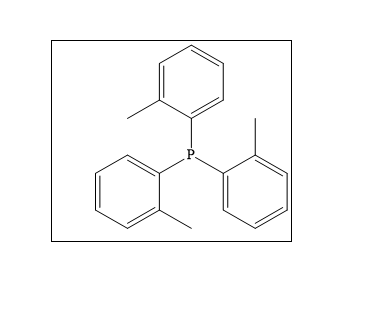
Physical properties:
Tri-o-tolylphosphine (CAS 6163-58-2) is a white to beige crystalline organo phosphorus compound (𝐶21𝐻21𝑃) used primarily as a bulky phosphine ligand in transition metal-catalyzed reactions, such as Heck and Suzuki couplings. It has a molar mass of 304.37 g/mol, a melting point of 124124-134∘C, and is known for its wide cone angle (194∘).
Key Properties:
Physical Appearance: White to light yellow crystalline solid or powder.
Melting Point: Typically 124-134∘C (lit.).
Solubility: Insoluble in water; soluble in organic solvents (e.g., benzene, toluene).
Molecular Weight: 304.373 g/mol.
Reactivity: Moderately stable, but can slowly convert to phosphine oxide in solution.
Applications: Ligand for ruthenium-catalyzed amination of alcohols and palladium-catalyzed cross-couplings.
Hazard Identification: Causes skin and eye irritation; very toxic to aquatic life with long-lasting effects.
Safety and Storage:
Storage Class: 11 (Combustible solids).
Handling: Use in well-ventilated areas, wear protective gloves and eye protection (PPE), and avoid breathing dust.
Storage: Keep container tightly closed in a cool place, often stored under inert gas.
Tri-o-tolylphosphine (CAS 6163-58-2) is a phosphine ligand commonly used in organic synthesis, notably for palladium-catalyzed reactions. Its primary synonyms include Tris(2-methylphenyl)phosphine, Tris(o-tolyl)phosphine, and Phosphine, tris(2-methylphenyl)-.
Key Synonyms and Identifiers for Tri-o-tolylphosphine (6163-58-2):
- Preferred IUPAC Name: Tris(2-methylphenyl)phosphane
- Common Name: Tris(o-tolyl)phosphine
- Systematic Name: Phosphine, tris(2-methylphenyl)-
- Abbreviation: 𝑃(𝑜−𝑡𝑜𝑙)3
- Other Variations: Tri-ortho-tolylphosphine, Tri-(o-tolyl)phosphine, Tri-o-tolylphosphine, 99%
- Molecular Formula: 𝐶21𝐻21𝑃
- MDL Number: MFCD00008514
- EC Number: 228-193-9
Tri(o-tolyl)phosphine (CAS 6163-58-2) is an organophosphorus ligand primarily used in transition metal-catalyzed cross-coupling reactions, such as Heck and Suzuki-Miyaura couplings, to improve reaction rate and selectivity. It is widely used in organic synthesis, including ruthenium-catalyzed alcohol amination, and in materials science for synthesizing advanced polymers.
Key Applications and Uses:
Ligand in Catalysis: Acts as a specialized phosphine ligand for palladium-catalyzed reactions (Heck, Suzuki) due to its high stability and ability to influence reactivity compared to triphenylphosphine.
Organic Synthesis: Facilitates cross-coupling of propargylic carbonates and other complex organic synthesis pathways.
Ruthenium-Catalyzed Reactions: Specifically employed as a ligand in the direct amination of alcohols.
Materials Science: Used in the development of materials, including polymer research, as noted in J&K Scientific.
Reagent Production: Used to prepare other reagents, such as tri-ortho-phosphinselenide by reacting with selenium.