Chemical Properties
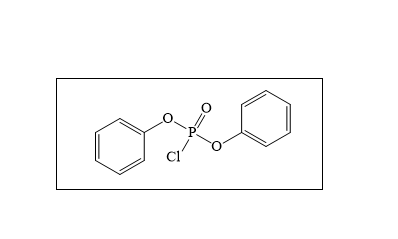
Formula: C12H10ClO3P
Molecular Weight: 268.63 g/mol
Physical State: Viscous, clear colorless to light yellow liquid
Boiling Point: 314–316 °C (lit.) or 190 °C at 10 mmHg
Density: 1.296 g/mL at 25 °C (lit.)
Refractive Index: 𝑛20/𝐷1.55 (lit.)
Flash Point: >230 °F (>110 °C)Stability: Stable under recommended storage conditions, but moisture-sensitive (hydrolyzes to diphenyl phosphate).
Solubility: Slightly soluble in chloroform and DMSO.
Synonyms
Diphenyl phosphoryl chloride
Diphenyl phosphorochloridate
Chlorodiphenoxyphosphine oxide
Diphenylphosphoric acid monochloride
Diphenyl chloridophosphate
Phosphorochloridic acid, diphenyl ester
DPPC, DPC, Dpcp
Uses and Applications
Diphenyl chlorophosphate acts as an electrophilic phosphorus center that reacts with nucleophiles like alcohols, amines, and carboxylic acids.
Pharmaceutical Synthesis: Used in the preparation of prodrugs to increase stability and in the synthesis of alpha-substituted beta-lactams, as well as methadone.
Nucleotide/Nucleoside Synthesis: Employed as a phosphorylating agent in the preparation of guanosine-adenosine-5′,5′-triphosphate, diguanosine-5′,5′-triphosphate, and other related compounds.
Peptide Chemistry: Acts as a reagent for forming mixed anhydrides, promoting peptide coupling.
Chemical Synthesis: Used to convert aldoximes to nitriles and to prepare aromatic polyesters.
Agrochemicals: Used in the synthesis of phosphorus-containing derivatives for agricultural use.
Others: Used in the synthesis of diaryl phosphoryl derivatives of alkylene dithiophosphates.
Safety and Handling
Hazardous: It causes severe skin burns and eye damage.
Reactivity: It is moisture-sensitive and can release hydrogen chloride and produce diphenyl phosphate.
Handling: Must be stored under an inert atmosphere (e.g., nitrogen) in a cool and dark place, preferably at 2–8°C, and handled with proper protection.
Diphenyl chlorophosphate (CAS 2524-64-3) is a highly reactive organophosphorus compound primarily used as a phosphorylating and chlorinating agent in chemical synthesis, particularly in pharmaceuticals and nucleotide chemistry. It is a colorless to light yellow liquid that is moisture-sensitive, often used in peptide synthesis and to create phosphorus-containing derivatives.