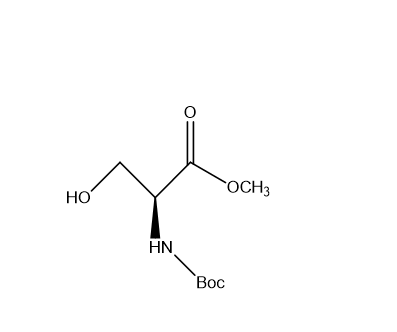
Boc-L-Serine Methyl Ester CASNO:2766-43-0
Physical properties:
Molecular Formula: C9H17NO5
Molecular Weight: 219.25
Appearance: Liquid or low-melting solid (light yellow)
Density: 1.082 G/Ml AT 25°
Flash Point: 113°C
Refractive Index: n20/D 1.452
Boiling Point: 354.3 ± 32°C at 760mmHg
Melting Point: 42°C
Solubility: Soluble in methanol
Optical Rotation: -18° to -20° (c=5 in MeOH)
Storage: 2-8°C
Synonyms:
Boc-Ser-OMe (most common abbreviation)
N-Boc-L-serine Methyl Ester
Boc-L-serine methyl ester
Methyl N-(tert-butoxycarbonyl)-L-serinate
N-tert-Butyloxycarbonyl-L-serine methyl ester
(S)-Methyl 2-((tert-butoxycarbonyl)amino)-3-hydroxypropanoate
L-Serine, N-[(1,1-dimethylethoxy)carbonyl]-, methyl ester
Boc-L-β-hydroxyalanine methyl ester
Uses:
- Peptide Synthesis: It is most commonly used in Boc solid-phase peptide synthesis. The Boc (tert-butyloxycarbonyl) group protects the amino group, while the methyl ester protects the carboxylic acid, allowing chemists to selectively build complex peptide chains.
- Pharmaceutical Research: It serves as a precursor or intermediate in drug discovery, used to develop bioactive compounds and new therapeutics.
- Biochemical Tools: Researchers use it to prepare specific biological markers like the Tn antigenand L-glutamic acid p-nitroanilide analogs.
- Material Science: It is used in the creation of new biomedical polymersthat feature serine and threonine side groups.
- Bioconjugation and Protein Engineering: It helps attach biomolecules to drugs or imaging agents and is used to modify proteins to improve their stability or activity.
Key Applications:
- Peptide Synthesis: Serves as a versatile building block, often used in solid-phase peptide synthesis (SPPS) and for preparing protected amino acids.
- Drug Development:Used in the development of new therapeutics and for synthesizing specialized compounds like Tn antigens and L-glutamic acid p-nitroanilide analogs.
-
- Bioconjugation: Employed to attach biomolecules to drugs or imaging agents to improve efficacy and targeting.
- Protein Engineering: Utilized in the modification of proteins to introduce specific functionalities that improve stability and activity.
2766-43-0 = 2,723
- Analytical Chemistry: Used in research applications for the identification and separation of complex mixtures.