
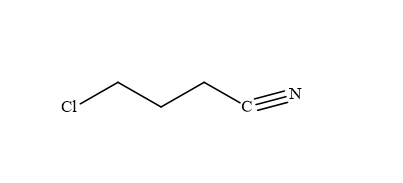
Introduction:
4-Chlorobutyronitrile, with the CAS number 628-20-6 , is a bifunctional organic compound featuring both a chloro and a cyano functional group.[1] This colorless liquid serves as a versatile intermediate in organic synthesis, particularly in the pharmaceutical and agrochemical industries.[2][3] Its dual reactivity allows for the strategic introduction of a four-carbon chain with a terminal nitrile, which can be further manipulated into various functional groups. This guide provides an in-depth overview of the properties, synthesis, and applications of this compound, with a focus on its role in the development of therapeutic agents.
4-Chlorobutyronitrile (CAS 628-20-6) is a colorless liquid organic compound with the molecular formula C₄H₆ClN. It functions as a valuable bifunctional building block in organic and medicinal chemistry, containing both chloro and cyano functional groups that allow for further synthetic transformations. A key application of this compound is its role as a precursor in the synthesis of pharmaceuticals, including the drugs buflomedil and buspirone. It also serves as a starting material for the synthesis of 2-phenylpyrrolidine, a key intermediate for a family of compounds known as pyrroloisoquinolines . These are investigated in medicinal chemistry as BAT substrate reuptake inhibitors, which can elevate synaptic concentrations of neurotransmitters like serotonin and catecholamines, showing potential for the treatment of CNS diseases and eating disorders. Furthermore, this compound can be cyclized to form cyclopropyl cyanide. The compound has a boiling point in the range of 189-191 °C and a density of approximately 1.09 g/cm³. It is toxic if swallowed, causes skin irritation, and causes serious eye irritation. This product is intended for research purposes only and is not intended for diagnostic or therapeutic use.
FAQs
The molecular formula of 4-chlorobutironitrile is C₄H₆ClN.


