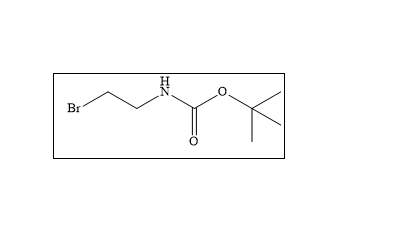
2-(Boc-amino)ethyl bromide (CAS 39684-80-5) is an organic compound commonly used as a building block in synthetic chemistry, particularly for introducing a protected aminoethyl group. It features a 2-bromoethylamine moiety protected with a tert-butoxycarbonyl (Boc) group, making it useful in the synthesis of pharmaceuticals, peptides, and other complex organic molecules.
Properties:
CAS Number: 39684-80-5
Molecular Formula: C₇H₁₄BrNO₂
Molecular Weight: 224.10 g/mol
Appearance: White to pale yellow, low-melting solid or powder
Melting Point: 30–32 °C
Solubility: Soluble in common organic solvents
Storage Temperature: Recommended storage at -20°C, under argon gas
Reactivity: The bromine atom makes it a good electrophile for nucleophilic substitution reactions.
Synonyms
- tert-Butyl (2-bromoethyl)carbamate
- tert-Butyl N-(2-bromoethyl)carbamate
- N-Boc-2-bromoethylamine
- N-(2-Bromoethyl)carbamic acid tert-butyl ester
- 2-(tert-Butoxycarbonylamino)ethyl bromide
Uses and Applications
Organic Synthesis & Medicinal Chemistry: Acts as a versatile intermediate for introducing a protected amine functionality (2-aminoethyl group) into molecules, useful in designing pharmaceuticals.
Peptide Synthesis: Used in the modification of peptides and synthesis of compounds requiring amine protection.
Functionalized Spacers: Used as a building block to prepare fluorinated spacers that have both nucleophilic and electrophilic termini.
Ligand/Linker Preparation: Used in the synthesis of biphenyl linkers and other molecular scaffolding.
Antimicrobial Studies: Acts as an affinity ligand for binding to bacterial or fungal cells.
Hazard Information
Signal Word: Warning
Hazard Statements:
H302: Harmful if swallowedH315: Causes skin irritation
H319: Causes serious eye irritation
H335: May cause respiratory irritation
Handling: Requires handling in a well-ventilated area with appropriate protective equipment (gloves, goggles).