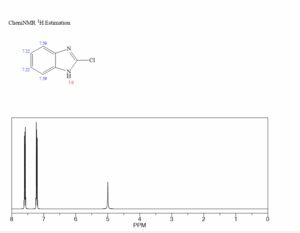
About This Product:
CAS Number : 4857-06-1
Molecular Weight : 152.58
Molecular Formula : C7H5ClN2
Synonym(s) : 2-Chloro-1H-benzo[d]imidazole
:2-CHLORO-1H-BENZOIMIDAZOLE; 2-chloro-1H-1,3-benzodiazole;oro-1H-benzimidazoL;
:2-Chlorobenzimidazol;Emestine Impurity 11; 2-CHLOROBENZIMIDAZOLE; 2-Chlorobenzoimidazole
Physical Properties:
Appearance : Off-White to Slight Yellow Powder
Purity : >98.00% (HPLC)
Assay by Titration : > 98%
(On Anhydrous basis)
Melting Point : 205°C – 208°C
Boiling Point : NA
Storage Temperature : Room temperature (recommended dark place)
Conditions to avoid : Moisture sensitive
LOD : NA
Moisture content : NMT 0.50%
Solubility : Soluble in Methanol
Description : It is primarily used in the pharmaceutical and agrochemical industries as a building block for various bioactive compounds like anti-allergy drugs, acid-related medications, and antifungal agents. It is a relatively stable compound that enables efficient synthesis in drug development.
Position of 2-Chlorobenzimidazole as a Key Building Block in Organic Synthesis:
This compound (C7H5ClN2) is a crystalline solid, appearing as a white to light yellow powder. It serves as a crucial intermediate and building block in the synthesis of a wide array of more complex organic molecules. The presence of a reactive chlorine atom at the 2-position of the benzimidazole ring makes it a versatile precursor for introducing various functional groups through nucleophilic substitution reactions.
The reactivity of this compound allows for its use in the creation of numerous derivatives. For instance, it can be alkylated to produce N-substituted-2-chlorobenzimidazoles. Furthermore, it is a key starting material for synthesizing compounds with applications in pharmaceuticals and agrochemicals. The synthesis of this compound itself can be achieved through methods such as the reaction of o-phenylenediamine with urea to form benzimidazol-2-one, followed by chlorination with phosphorus oxychloride and phosphorus trichloride.
Overview of Research Directions in this compound Chemistry
Current research involving this compound is multifaceted, exploring its utility in various scientific domains. A significant area of focus is its application in the development of novel pharmaceuticals, particularly in the synthesis of potential anticancer and anti-inflammatory agents. In the field of agricultural science, it is utilized in the formulation of fungicides and herbicides.
Moreover, this compound is employed in material science to enhance the properties of polymers and coatings. It also serves as a versatile reagent in laboratory settings for the synthesis of new chemical entities and in biochemical studies investigating enzyme inhibition and receptor binding. The ongoing exploration of this compound’s reactivity and its derivatives continues to open new avenues for innovation in drug discovery, materials science, and beyond. The development of greener synthetic methods for its derivatives is also an active area of investigation.
ucleophilic Substitution Reactions at the C2 Position
The C2 position of the benzimidazole ring is susceptible to nucleophilic substitution, although the reactivity is highly dependent on the substitution at the N1 position. For the parent this compound, the presence of the acidic N-H proton complicates substitution. Strong nucleophiles tend to abstract this proton, forming the N-anion, which is not capable of facilitating nucleophilic substitution at the 2-position. Consequently, the chloride ion is not readily displaced from this compound by potent nucleophiles.
However, this limitation is overcome by N-alkylation. For example, 2-chloro-1-methylbenzimidazole reacts readily with nucleophiles like sodium methoxide or sodium ethoxide to yield the corresponding 2-alkoxy derivatives. Similarly, reacting 2-chloro-1-isopropenylbenzimidazole with sodium alkoxides produces 2-alkoxy-1-isopropenyl-benzimidazoles. These can then be oxidized to provide 2-alkoxybenzimidazoles that are unsubstituted at the 1-position. This two-step sequence allows for the synthesis of compounds that are not directly accessible from this compound itself. The reaction with water or hydroxide ions can lead to the formation of benzimidazolin-2-ones.
Cross-Coupling Reactions (e.g., Palladium-Catalyzed with Arylboronic Acids)
The chlorine atom at the C2 position of this compound makes it a suitable substrate for palladium-catalyzed cross-coupling reactions, such as the Suzuki-Miyaura reaction with arylboronic acids. This reaction is a powerful tool for forming carbon-carbon bonds and synthesizing 2-arylbenzimidazoles, which are significant structural motifs in medicinal chemistry.
The general mechanism involves the oxidative addition of the this compound derivative to a palladium(0) complex, followed by transmetalation with the arylboronic acid and subsequent reductive elimination to yield the 2-arylbenzimidazole product and regenerate the palladium(0) catalyst. The efficiency of these reactions can be influenced by the choice of ligands, base, and solvent system. The use of N-heterocyclic carbene (NHC) ligands, for example, has been shown to be effective in the coupling of various aryl chlorides with phenylboronic acid. These reactions provide a versatile route to a wide array of functionalized 2-substituted benzimidazoles under relatively mild conditions.
Cycloaddition Reactions
Theoretical studies have explored the [3+2] cycloaddition reaction between this compound and benzonitrile oxide. This reaction is of interest for the synthesis of fused heterocyclic systems, specifically 3-phenyl oxadiazolo[4,5-a]benzimidazole.
Computational studies, using density functional theory (DFT), have shown that the reaction pathway and its favorability are significantly influenced by the solvent. The presence of a polar protic solvent, such as methanol (MeOH), is found to favor the reaction. The analysis of Wiberg indices indicates that the transition states in the reaction are earlier in methanol compared to less polar solvents like tetrahydrofuran (THF) or in the gas phase. This suggests that polar solvents can stabilize the transition state, thereby lowering the activation energy and facilitating the cycloaddition. The solvent polarity can play a crucial role in determining the regioselectivity of cycloaddition reactions, sometimes leading to different ratios of isomeric products.
A concerted reaction is a chemical process where all bond-breaking and bond-making occur in a single step through a single transition state. In contrast, a non-concerted reaction proceeds through multiple steps involving one or more intermediates.
For the cycloaddition of this compound with benzonitrile oxide, theoretical analysis indicates that a concerted [3+2] mechanism is not possible. Instead, the reaction proceeds through a non-concerted pathway. Topological analysis of the electron localization function (ELF) reveals that the formation of the new N4–C3 and C5–O bonds and the breaking of the C5–Cl bond occur via tetrahedral intermediates. This step-wise formation and breaking of bonds, marked by the presence of an asynaptic basin, confirms the non-concerted nature of the mechanism. The most probable route involves the presence of anionic species of this compound.
Metalation Studies (e.g., N- and C-Metalation with Ni(0))
Benzimidazole derivatives are effective ligands for forming stable complexes with various transition metals, including nickel. The nitrogen atoms of the imidazole ring can coordinate with metal ions. Specifically, in 2-substituted benzimidazoles, the nitrogen at position 3 acts as a coordination site.
While specific studies on the N- and C-metalation of this compound with Ni(0) are not extensively detailed, the broader chemistry of benzimidazole-metal interactions provides relevant insights. Nickel (II), for example, readily forms complexes with 2-(phenylsubstituted) benzimidazole ligands. In these complexes, the benzimidazole derivative typically acts as a monodentate or bidentate ligand. The coordination can involve the imidazole nitrogen and, if present, other donor atoms on the C2 substituent, such as a hydroxyl group on a phenyl ring. Complexation with metals like nickel can enhance the biological activity of the benzimidazolescaffold.