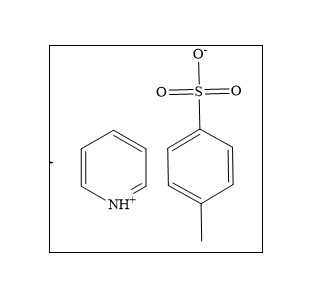
Physical properties:
Pyridinium-P-Toluenesulfonate (PPTS), CAS 24057-28-1, is a white to off-white crystalline solid, widely used as a mild, non-hygroscopic acid catalyst in organic synthesis, particularly for protecting group chemistry (e.g., THP ether formation) and acid-sensitive reactions. It is soluble in polar solvents (alcohol, chloroform) and has a molecular weight of 251.30 g/mol, a melting point of ~117–120 °C, and a 𝑝𝐾𝑎 of 5.21.
Key Properties & Specifications
Appearance: White to off-white powder or crystals.
Formula: 𝐶12𝐻13𝑁𝑂3𝑆.
Molecular Weight: 251.30 g/mol.
Melting Point: 117-120 °C.
Acidity (𝑝𝐾𝑎): 5.21.
Solubility: Soluble in water, ethanol, and acetone; low solubility in nonpolar solvents like hexane.
Stability: Stable under normal temperatures.
Assay: Typically 98%–99% pure.
Main Applications
- Catalyst: Used as a mild catalyst in place of 𝑝-toluenesulfonic acid (𝑇𝑠𝑂𝐻) to prevent over-protonation of delicate substrates.
- Protecting Groups: Highly efficient for the formation of tetrahydropyranyl (THP) ethers and the cleavage of acetals.
- Organic Reactions: Facilitates esterifications, transesterifications, and cationic rearrangements.
Handling & Storage
Storage: Store in a cool, dry place, often recommended to keep under inert gas or in a tightly closed container, protected from moisture (below 15°C).
Safety: It is considered a mild acid. Standard laboratory precautions should be taken (avoid inhaling dust, wear protective equipment
Pyridinium p-toluenesulfonate (CAS 24057-28-1), commonly known as PPTS, is a mild acid catalyst used in organic synthesis. Key synonyms include pyridine p-toluenesulfonate, 𝑝-toluenesulfonic acid pyridine salt, and pyridinium tosylate. It is typically used as a catalyst for protecting group manipulations, such as forming tetrahydropyranyl (THP) ethers.
Key Synonyms and Names:
PPTS
Pyridine p-toluenesulfonate
p-Toluenesulfonic acid pyridine salt
Pyridinium tosylate
Pyridinium toluene-4-sulphonate
4-Methylbenzenesulfonic acid pyridinium salt
Pyridinium 4-toluenesulfonate
Key Information:
CAS Number: 24057-28-1
Molecular Formula: 𝐶12𝐻13𝑁𝑂3𝑆(or 𝐶5𝐻5𝑁⋅𝐶7𝐻8𝑂3𝑆)
Molecular Weight: 251.30 g/mol
Description: White, moisture-sensitive crystalline solid.
Usage: Used in synthesis as a mild alternative to 𝑝-toluenesulfonic acid for the protection and deprotection of alcohols
Pyridinium-p-toluenesulfonate (PPTS, CAS 24057-28-1) is a mild, non-hygroscopic, and organic-soluble acid catalyst used widely in organic synthesis for protective group manipulation, such as the creation of tetrahydropyranyl (THP) ethers and acetals. It is crucial in pharmaceutical research, fine chemical production, and as a catalyst for aldol condensations and Claisen rearrangements.
Key Applications and Uses:
Protecting Group Chemistry: Used for the mild protection of alcohols as THP ethers and the deprotection of silyl ethers, particularly when substrates are sensitive to stronger acids.
Acetal/Ketal Formation: Catalyzes the preparation of acetals and ketals from aldehydes and ketones.
Organic Synthesis Catalyst: Acts as a Lewis acid catalyst in reactions such as the Claisen rearrangement (vinyl ether to allyl vinyl ether) and diastereoselective Henry reactions.
Pharmaceutical Industry: Employed in the synthesis of complex pharmaceutical ingredients, including the construction of enzyme subdomains like cytochrome P450 BM3 for drug screening.
Regioselective Reactions: Used in CAN-mediated regioselective azidoalkoxylation of enol ethers.
Co-catalyst: Enhances yield and enantioselectivity when used alongside L-proline in asymmetric aldol condensation reactions.
PPTS is preferred for its high solubility in solvents like dichloromethane and alcohol, and its relatively low toxicity compared to other acidic reagents.