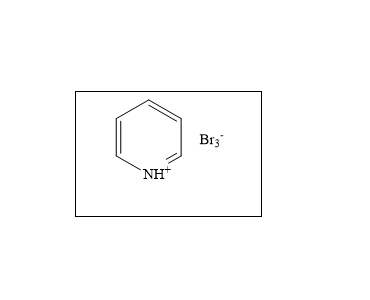
Physical Properties:
Pyridinium tribromide (PTB, CAS 39416-48-3) is a dark red/brown solid, highly efficient brominating agent used in organic synthesis to substitute for volatile liquid bromine. It is a selective agent for alkene and aromatic bromination, characterized by a melting point of 127–137∘C and formula 𝐶5𝐻6𝐵𝑟3𝑁. The compound is hygroscopic and causes severe skin/eye burns.
Key Chemical & Physical Properties
Molecular Formula: 𝐶5𝐻6𝐵𝑟3𝑁
Molecular Weight: 319.82 g/mol
Appearance: Red to orange/brown powder, crystals, or chunks
Melting Point: 127–137∘C
Solubility: Soluble in polar solvents like methanol; decomposes in water
Stability: Stable but hygroscopic, necessitating storage in a cool, dark, dry place
Density: ∼2.96g/cm3
Uses and Characteristics
Brominating Agent: Used for the selective bromination of ketones, alkenes, and aromatic compounds.
Advantages: It is easier to handle than liquid molecular bromine (𝐵𝑟2), as it is a solid, stable at room temperature, and less volatile.
Reactivity: Acts as a solid source of bromine, generally providing good selectivity in synthesis.
Safety and Handling
Hazard Class: UN 3261 (Corrosive solid, acidic, organic).
Safety Phrases: Causes severe skin burns and eye damage.
Handling: Must be used in a well-ventilated area with appropriate protective equipment.
Sensitive: Lachrymatory
Pyridinium tribromide (PTAB), with the CAS number 39416-48-3, is a versatile brominating agent in organic synthesis. It is often referred to by several synonyms related to its chemical composition, which consists of a pyridinium cation and a tribromide anion (𝐶5𝐻5𝑁𝐻+𝐵𝑟−3).
Primary Synonyms
Pyridinium bromide perbromide (commonly used name)
Pyridine hydrobromide perbromide
Pyridinium perbromide
Pyridine perbromide hydrobromide
Other Technical/Chemical Synonyms
- Hydrogen tribromide, compd. with pyridine (1:1)
- Pyridine, (hydrogen tribromide)
- Pyridine, bromide, hydrogen salt (1:3)
- NSC 61191
- PHBP (Abbreviation for Pyridinium HydroBromide Perbromide)
- 2l3-tribromane–pyridine (1/1)
Commonly Associated Trade/Product Names
- Pyridinium tribromide, technical grade
- Pyridinium bromide-perbromide for synthesis
Pyridinium tribromide (PTB, CAS 39416-48-3) is a stable, solid, and easy-to-handle brominating agent used in organic synthesis. Its primary applications include the selective 𝛼-bromination of ketones, phenols, and ethers. It is also employed for adding bromine across double or triple bonds, oxidizing alcohols, and synthesizing pharmaceutical intermediates, including 𝛽-blockers.
Key Uses and Applications
- Selective Bromination: Used as a milder alternative to molecular bromine (
𝐵𝑟2) for the bromination of unsaturated compounds (alkenes and alkynes) to form vicinal dibromides.
- Alpha-Bromination of Carbonyls: It efficiently brominates ketones at the 𝛼-position, a key step in organic synthesis, for example, the bromination of 3-ketosteroid to 2,4-dibromocholestanone.
- Pharmaceutical Synthesis: Extensively applied in the synthesis of active pharmaceutical ingredients (APIs), including 𝛽-adrenergic blocking agents (beta-blockers) to treat heart conditions, according to CymitQuimica and nordmann.global.
- Oxidation Reactions: PTB can be used for the oxidation of alcohols, aldehydes, and ketones to their corresponding carbonyl bromides, notes NINGBO INNO PHARMCHEM CO.,LTD..
- Agrochemicals: Used in the production of agricultural chemicals, including specific herbicide intermediates.
- Organic Synthesis Reagent: Used for the 𝛼-thiocyanation of ketones and in various cyclization reactions Advantages
- Stable Solid: Unlike liquid bromine, it is a stable solid, making it safer and easier to weigh and handle, especially for small-scale lab reactions,
- Selective: Allows for precise bromination without damaging other parts of the molecule, which is critical in delicate synthesis.
Physical Properties
Formula: 𝐶5𝐻6𝐵𝑟3𝑁 or 𝑃𝑦⋅𝐻𝐵𝑟3).
Appearance: Yellowish solid.
Solubility: Soluble in common organic solvents like dichloromethane, chloroform, and ether.