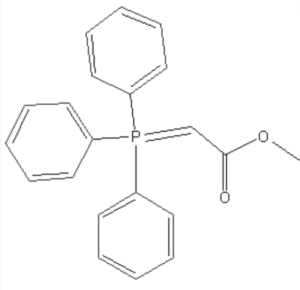
About This Product:
CAS Number : 1099-45-2
Molecular Weight : 348.37
Molecular Formula : C22H21O2P
Linear Formula : (C6H5)3P=CHCO2CH2CH3
Synonym(s) : Ethyl (triphenylphosphoranylidene) acetate, CMTPP,
(Ethoxycarbonylmethylene) triphenylphosphorane,
(Triphenylphosphoranylidene) acetic Acid Ethyl Ester,
Acetic acid, (triphenylphosphoranylidene)- ethyl ester,
Triphenylcarbethoxymethylenephosphorane,
Ethyl 2-(triphenylphosphoranylidene) acetate.
Physical Properties:
Appearance : White to off-white colored solid
Purity : ≥ 95% (HPLC)
Melting Point : 126°C – 130°C
Storage Temperature : 2°C to 8°C
Conditions to avoid : Air sensitive and Heat sensitive
LOD (at 80 ± 5°C) : NMT 0.50%
Solubility : Soluble in Methanol
( Cabethoxymethylene) triphenylphosphorane ,We is a Horner-Wittig reagent generally used in Horner−Wadsworth−Emmons (HWE) reaction. It is used as a reagent in the total synthesis of compounds such as Oseltamivir, Nakadomarin and (−)-Dictyostatin.
Key Uses of Carbethoxymethylene)triphenyl Phosphorane CAS 1099-45-2
- Wittig & HWE Reactions: Converts aldehydes/ketones into alkenes, forming C=C bonds for building complex organic structures.
- Pharmaceuticals: Used in synthesizing drug candidates, acting as a cholinesterase inhibitor for neurodegenerative disease research.
- Heterocycle Synthesis: Forms ring structures like indoles and coumarins from specific precursors.
- Chemical Research: Studies reaction mechanisms, develops new synthetic methods, and explores phosphorus chemistry.
- Materials Science: Can be used in synthesizing polymers and exploring new functional materials.
Key Applications of Carbethoxymethylene)triphenyl Phosphorane CAS 1099-45-2
- Organic Synthesis: The core application is in the Wittig and HWE reactions to convert carbonyl compounds (aldehydes/ketones) into alkenes, especially α,β-unsaturated esters.
- Pharmaceuticals: Used in synthesizing drug intermediates and Active Pharmaceutical Ingredients (APIs) for drugs with conjugated structures, including anti-inflammatory, anticancer, and antiviral agents.
- Natural Product Synthesis: A reagent in the total synthesis of complex natural products like Oseltamivir (Tamiflu) and Nakadomarin A.
- Material Science: Applied in creating functionalized polymers, specialty coatings, and advanced electronic materials.
- Fine Chemicals: Serves as a versatile building block for various fine chemicals.
(Carbethoxymethylene)triphenylphosphorane is a Horner-Wittig reagent used in organic synthesis, primarily in the Horner-Wadsworth-Emmons (HWE) reaction to form carbon-carbon double bonds. Its application includes serving as a reagent in the total synthesis of complex molecules, such as the antiviral drug oseltamivir and the natural products (+)-nakadomarin A and (−)-dictyostatin. It is also noted as a cholinesterase inhibitor and used in some analytical chemistry techniques.
Applications
Organic Synthesis of Carbethoxymethylene)triphenyl Phosphorane CAS 1099-45-2:
- Horner-Wadsworth-Emmons (HWE) Reaction:Its primary use is as a reagent in this reaction, which forms carbon-carbon double bonds.
- Total Synthesis:It is a key intermediate in the total synthesis of complex organic compounds, including:
- (−)-oseltamivir
- (+)-nakadomarin A
- (−)-dictyostatin
Biochemical Research:
- Cholinesterase Inhibitor:It is identified as a cholinesterase inhibitor, a class of compounds that block the breakdown of the neurotransmitter acetylcholine.
- Analytical Chemistry:
Used in some analytical techniques to help identify and quantify phosphorus species.
(Carbethoxymethylene)triphenylphosphorane is used as a reagent in organic synthesis, primarily in the Horner-Wadsworth-Emmons (HWE) reaction, to create carbon-carbon double bonds. It serves as a Wittig reagent and is a valuable intermediate in the total synthesis of complex molecules, including pharmaceuticals like oseltamivir and natural products such as (+)-nakadomarin A and (−)-dictyostatin.
Horner-Wadsworth-Emmons (HWE) reaction: This is the primary application, where it reacts with carbonyl compounds (aldehydes and ketones) to form \(\alpha \), \(\beta \)-unsaturated esters.
Total synthesis: It is a key reagent in the multi-step synthesis of various complex organic compounds.
Pharmaceuticals: It is used in the synthesis of drugs like oseltamivir.
Natural products: It is also employed in the synthesis of natural products such as (+)-nakadomarin A and (−)-dictyostatin.
Chemical reaction
The general reaction can be simplified as:
R2C=O + (EtO2CCH2)P(Ph3)→ R2C=CHCO2Et + O=P(Ph3)
Applications in Natural Product Total Synthesis
The reliability and predictability of the Wittig reaction with Carbethoxymethylene)triphenyl Phosphorane (CAS 1099-45-2,Have made it an indispensable tool in the total synthesis of natural products. Its ability to form carbon-carbon double bonds with control over stereochemistry is crucial for constructing the carbon skeletons of complex molecules.
Lignans are a large and diverse class of natural products characterized by the coupling of two phenylpropanoid units. Their synthesis often involves the strategic formation of carbon-carbon bonds to assemble the core structure. While specific examples directly employing (Carbethoxymethylene)triphenylphosphorane in recent lignan syntheses are not extensively detailed in the provided context, the Wittig reaction is a fundamental transformation that can be readily applied in this area. For instance, an aldehyde precursor containing one phenylpropanoid unit could be reacted with (Carbethoxymethylene)triphenylphosphorane to introduce a two-carbon extension with an ester functionality. This ester can then be further manipulated (e.g., reduced to an alcohol or converted to other functional groups) to facilitate the coupling with the second phenylpropanoid unit, ultimately leading to the lignan scaffold.
Macrocycles are large ring structures that are prevalent in many biologically active natural products. The formation of these large rings, known as macrocyclization, can be challenging due to entropic factors. The Wittig reaction, including intramolecular versions, has proven to be an effective strategy for macrocyclization. In one example, a macrocycle was synthesized in a one-stage Wittig reaction from 2,2′-bis(triphenyl-phosphoniomethyl)biphenyl dibromide and isophthalaldehyde using sodium ethoxide as a base. Although this specific example does not use (Carbethoxymethylene)triphenylphosphorane, the principle of using a Wittig reaction to form a large ring structure is well-established. An intramolecular Wittig reaction involving a molecule containing both an aldehyde and a phosphonium (B103445) salt derived from a precursor that could be formed using (Carbethoxymethylene)triphenylphosphorane is a viable strategy for macrocycle synthesis.
C-glycosides are carbohydrate derivatives in which the anomeric carbon is linked to an aglycone via a carbon-carbon bond, in contrast to the more common O-glycosides. This C-C linkage makes them resistant to enzymatic hydrolysis, which is a desirable property for potential therapeutic agents. The synthesis of C-glycosides often involves the reaction of a sugar-derived electrophile with a carbon nucleophile. (Carbethoxymethylene)triphenylphosphorane can be employed in the synthesis of C-glycosides by reacting it with a sugar-derived aldehyde. This would install an α,β-unsaturated ester moiety onto the sugar ring, which can then be further elaborated to the desired C-glycoside structure. For example, the double bond of the unsaturated ester can be hydrogenated or subjected to other addition reactions to create the final C-glycoside.
Benzocoumarins are a class of polycyclic aromatic compounds that exhibit a range of biological activities. The synthesis of these scaffolds can be efficiently achieved using the Wittig reaction. For instance, the reaction of ortho-hydroxynaphthaldehydes with (Carbethoxymethylene)triphenylphosphorane under heating conditions in aprotic solvents like benzene (B151609) or xylene leads to the formation of benzo[g]coumarins. This method is advantageous as it allows for the introduction of various functional groups at the C3 position of the coumarin ring system.