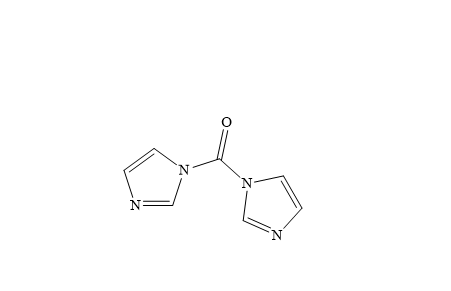
Key Uses:
- Peptide Synthesis: Activates carboxylic acids to form amide bonds, a fundamental process in creating peptides and polypeptides.
- Pharmaceuticals: Used in producing APIs (Active Pharmaceutical Ingredients) and veterinary drugs, forming amides, carbamates, and ureas.
- General Organic Synthesis: Forms esters, carbonates, and anhydrides, and facilitates cyclization and substitution reactions.
- Material Science: A coupling agent in synthesizing dipolar polyamides for nonlinear optical applications.
- Safer Phosgene Alternative: Replaces highly toxic phosgene in various syntheses, aligning with greener chemistry principles.
Common Reactions:
- Carboxylic Acid Activation: Converts acids into reactive imidazolides, ready for reaction with amines, alcohols, or thiols.
- Amide/Ester/Carbamate Formation: Efficiently creates these bonds under mild conditions.
- Glycosidic Bond Formation: Used in making carbohydrate linkages.
Key Applications:
- Peptide & Amide Synthesis:CDI activates carboxylic acids to form imidazolides, enabling efficient coupling with amines to create amide bonds, crucial in peptide synthesis and API (Active Pharmaceutical Ingredient) production.
- Greener Chemistry:Acts as a phosgene substitute, offering a safer, more environmentally friendly method for introducing carbonyl groups.
- Ester & Carbonate Formation:Used to synthesize esters, carbonates, and anhydrides from carboxylic acids.
- Carbamate Synthesis:Enables the green synthesis of carbamates, important in pharmaceuticals and agrochemicals.
- Cyclization Reactions:Facilitates the creation of cyclic compounds, expanding its use in drug discovery.
- Food & Material Science:Used in synthesizing deuterated triglycerides for food emulsion studies and in developing advanced materials like nanoflower sensors for contaminant detection.
FAQs 1,1’-Carbonyldiimidazole (530-62-1) is available from certified chemical suppliers and laboratory reagent manufacturers.